ट्याग: Democracy
Analysis Update 12 – Campaign Period Incidents Prior to the Third Phase Local Elections
There were eleven election-related incidents recorded during the campaign period for the September 18 third phase of local elections that ran from September 6 to 15. This was the lowest number of incidents recorded during all three phases of elections, with 56 incidents recorded during the first phase campaign period, and 89 incidents recorded during the second phase campaign period.
Analysis Update 11 – Incidents Prior to Nomination for the Third Phase Local Election
There was a small increase in the number of election-related incidents during this reporting period. This increase can be attributed to parties beginning preparations for the third phase of local elections that are scheduled for September 18. Seven election-related incidents were recorded between August 3 and September 5.

Preliminary Statement on June 28 Second Phase Local Elections (Aug 2017)
On June 28, 2017 the Second Phase of local elections was held in Provinces 1, 5, and 7. Voters in newly formed local units turned out in impressive numbers to elect new representatives for the first time in nearly 20 years. Democracy Resource Center Nepal (DRCN) conducted observation of the elections in order to provide a critical, independent, and high-quality assessment of the electoral and political processes around the elections. This preliminary statement outlines findings and makes recommendations based on DRCN‟s observation before, during, and after the Second Phase elections.

Factsheet 2 – Local Level Election, Silence Period and Election Day: Second Phase
On June 28, 2017, more than 6.4 million voters were called upon to participate in the second phase of Nepal’s local polls, electing more than 15,000 local representatives in 334 local units across Provinces 1, 5, and 7. According to the Election Commission of Nepal voter turnout was 73.69 percent, similar to the May 14 first phase elections. Polling was postponed until September 18 in Province 2 after the government could not reach an agreement with agitating Rastriya Janata Party Nepal (RJPN).
Analysis Update 4 – Incidents and Electoral Environment around Local Elections
After the Madheshi Morcha1 withdrew its support from the government2 on March 15, Morcha cadres intensified protests across the Tarai while demanding that the constitution be amended before local elections.3 From April 1-21, 51 incidents related to the local-elections and local-level-restructuring were reported across Nepal.
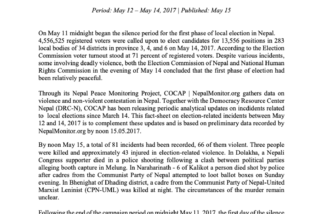
Factsheet 1 – Electoral Violence and Contestation during Nepal’s Local Election
On May 11 midnight began the silence period for the first phase of local election in Nepal. 4,556,525 registered voters were called upon to elect candidates for 13,556 positions in 283 local bodies of 34 districts in province 3, 4, and 6 on May 14, 2017. According to the Election Commission voter turnout stood at 71 percent of registered voters. Despite various incidents, some involving deadly violence, both the Election Commission of Nepal and National Human Rights Commission in the evening of May 14 concluded that the first phase of election had been relatively peaceful.

DRCN Pre-Election Statement, May 2017
This pre-election statement focuses on a few key findings identified by observers since May 1. A more comprehensive preliminary statement of observer findings will be released after the elections, and a final observation report will be released at the completion of observation.